
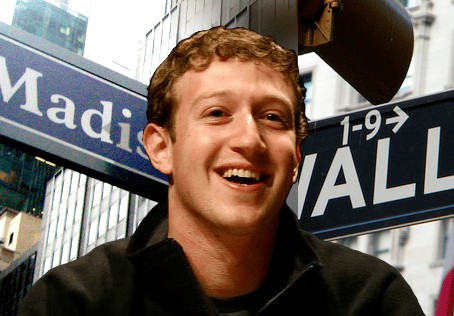
Facebook has made a $3.1 billion business from a social advertising sector many, even it, concede is experimental and unproven. Now it must find that proof. But experimenting on Wall Street, as well as Madison Avenue, could prove challenging.
“Our advertisers typically do not have long-term advertising commitments with us,” Facebook’s S-1 warned. “Many of our advertisers spend only a relatively small portion of their overall advertising budget with us.
“In addition, advertisers may view some of our products, such as sponsored stories and ads with social context, as experimental and unproven.
“Advertising on the social web is a significant market opportunity that is still emerging and evolving. We believe that most advertisers are still learning and experimenting with the best ways to leverage reach, relevance, social context, and engagement offered by Facebook.”
Facebook manages to target standard display advertising very well because it knows so much about users, but the biggest opportunity may yet lay in getting users to participate in and distribute to their friends ad campaigns that are part of their social experience may yet hold greater promise. It is a long way from there, however.
Forrester analyst Nate Elliott cautions (via Reuters): “I worry that the billions of dollars of revenue that they generated last year aren’t as solid as they need to be because the advertisers who spent the money aren’t as thrilled with the results they got for it.”
Amongst advertising’s biggest skeptics is advertising’s biggest beast. WPP CEO Sir Martin Sorrell thinks advertisers will be challenged to reach social network users without offending them, making Facebook a better PR and word-of-mouth medium than a straight advertising one.
Indeed, Facebook has been trying to strike that very balance. But, with its quest to roll out the perfect formats still ongoing, Facebook has made frequent missteps along the way, such as its Beacon system, which proposed sharing users’ web purchases to friends before it was aborted.
Today, less than half a percent of people who Like big brands’ Facebook Pages actually bother to engage with them, according to new research from the Ehrenberg-Bass Institute.
Social is not Facebook’s only advertising play. Its offering today is focused mainly around display ads that run alongside users’ feeds. Here, Facebook is so big that, in some key markets like the U.S. and UK, it’s actually the biggest player of all in display advertising – social or otherwise – leaving those that effectively created the display field — Yahoo (NSDQ: YHOO), AOL (NYSE: AOL) and others — in the dust.
But it’s social advertising where perhaps the greatest potential lays. And frankly Facebook, like its advertisers, has not yet cracked the nut; that mission goes on.
If, previously, upgrades like Beacon, Timeline and its perpetual redesigns have prompted user outcry, expect future responses to manifest as share price fluctuation when such revisions take place in the public glare of Wall Street.
Still, users’ redesign shock often subsides, stock price can rebound accordingly. And, if Facebook can execute fully on the social advertising holy grail, it can become spectacularly successful.
None of this looks very problematic today. In 2011, Facebook advertising revenue rose 69 percent because it showed 42 percent more advertising thanks to a growing user base; it scored an 18 percent higher price per ad.
But Facebook concedes these growth rates may not be sustainable. “Our user growth has been a primary driver of growth in our revenue,” its S-1 says. “But “our rates of user and revenue growth will decline over time”, especially in the west.
One Facebook ad buying agency thinks that slowdown could be a good thing…
“The market has now entered a phase where there is no longer any super-growth in user numbers to dilute the increases in cost caused by demand increases,” Alchemy Social managing director Will Ashton writes in a new white paper. “As such, we expect costs to increase at rates substantially higher than those we have seen previously.”
In other words, advertisers rushing to Facebook are driving up demand, but the slowdown in Facebook user growth suggests finite supply, driving up the rates it can charge.
Outside the west, Facebook has a huge opportunity in mobile, having gathered 425 million users. But it’s not monetising a single one because it is not selling any ads through mobile. Worse – until then, mobile success could actually hurt the company from within…
“Growth in use of Facebook through our mobile products, where we do not currently display ads, as a substitute for use on personal computers may negatively affect our revenue and financial results,” the company warns. “Our ability to (generate mobile revenue) successfully is unproven.”
$3.1 billion in 2011 ad revenue suggests Facebook is well on its way. What an amazing number for such a young paradigm. But some investors may question whether much of that was short-term experimentation by advertisers, meaning Facebook must work hard to prove its value to them as much as they have to itself.